Showing posts with label culture. Show all posts

Thursday, December 6, 2012

The Installation of D.Y.M.M. Yang Di-Pertuan Agong

HIS MAJESTY THE YANG DI-PERTUAN AGONG

His Majesty Tuanku Abdul Halim Mu’Adzam Shah ini Al-Marhum Sultan Badlishah was elected as the 5th Yang Di-Pertuan Agong by the Conference of Rulers on the 23rd July, 1970.

A nephew of Tengku Abdul Rahman Putra Al-Haj, the first Prime Minister, and the son-in-law of the first Yang Di-Pertuan Agong, he was born on the 28th November, 1927 at Anak Bukit, Kedah, and educated at the Sultan Abdul Hamid College, Alor Star.

In 1949, he went to England, where he read political science and took a diploma course in social and public administration for three years at Wadham College, Oxford. After graduating he accompanied his father on a tour of Scandinavia. Later he accompanied his brother, Tengku Abdul Malik, on a tour of Holland, Germany and Spain.

His Majesty met his attractive consort Tengku Bahiyah binte Al-Marhum Tuanku Abdul Rahman of Negri Sembilan when she was studying domestic science in England. They were married on their return to Malaysia in March, 1956 at Sri Menanti.

Following this, he was attached to the District Office in Alor Star and later to the Treasury until late 1958.

On the 6th August, 1949, he was appointed Raja Muda, became heir apparent eight years later and then Regent of Kedah when his father went to Britain for an operation. On the demise of his father on the 14th July, 1958, he was proclaimed Sultan of Kedah and formally installed on the 20th February, 1959. Accompanied by his consort, he went on a world tour in 1963.

As the Timbalan Yang Di-Pertuan Agong, to which office he was elected in 1965, he acted for the Yang Di-Pertuan Agong on a number of occasions when the King was indisposed. He was host for the State visit of King Faisal of Saudi Arabia in June, 1970; for President Soeharto of Indonesia in March; and Japan’s Crown Prince Akihito and Princess Michiko in February the same year.

His Majesty is the holder of the following Orders and Decorations:

  1. Darjah Kerabat Yang Amat Mulia Kedah (D.K.)
  2. Darjah Utama Sri Mahkota Negara (D.M.M.)
  3. Darjah Utama Kedah (D.U.K.)
  4. Darjah Kerabat Yang Amat Di-Hormati Kelantan (D.K. Kelantan)
  5. Darjah Kerabat Sri Indra Mahkota Pahang (D.K. Pahang).
  6. Sri Paduka Mahkota Kedah (S.P.M.K.)

A keen sportsman, His Majesty plays golf; photography, both still and cine, is another hobby.

Technical Details
Commemorative postage stamps of 10 cents, 15 cents and 50 cents denominations will be issued to mark the Installation of His Majesty the Yang di-Pertuan Agong of Malaysia. Details of the stamps are as follows:

Size: Rectangular in shape in a vertical format with the following dimensions perforation to perforation:

Vertical – 35 mm
Horizontal – 25 mm

Design: The three stamps feature the portrait of His Majesty the Yang di-Pertuan Agong.

Colours:
10 cent – Black and white portrait against a yellow background. The letterings and denomination in gold.

15 cent – Black and white portrait against a purple background. The letterings and denomination in gold.

50 cent – Black and white portrait against a blue background. The letterings and denomination in gold.

Artist: The design and artworks were prepared by Union Art Corporation, Kuala Lumpur.

Printing Process: Photogravure.

Paper: Unwatermarked white paper.

Printed by: Messrs. Harrison & Sons Ltd., England

Period of Sale: Until stocks are exhausted

First Day Cover
 

Monday, November 26, 2012

The Installation of His Highness The Sultan of Perak

BIOGRAPHY OF DULI YANG MAHA MULIA SULTAN IDRIS AL-MUTAWAKIL ALLAHI SHAH, SULTAN OF PERAK
Duli Yang Maha Mulia Raja Idris is the son of a former Sultan of Perak, Sir Alang Iskandar Shah, G.C.M.G., K.C.V.O. (30th). He was born in Kuala Kangsar on 28th August, 1924. Like other members of the Perak Royalty he received his early education at Bukit Chandan Malay School and Clifford School, Kuala Kangsar, and later continued his education at the Malay College, Kuala Kangsar.

When he was only ten years old he was appointed Di-Hilir of Perak, and when his father passed away in 1938 he was raised to the rank of Raja Bendahara.

In the latter part of 1946 he was attached to the Perak Secretariat for administrative experience. During the flood in 1947 he was appointed a member of the Perak State Flood Relief Committee. This appointment gave him an outlet for his youthful energy and enthusiasm, and those who observed his untiring efforts had occasion to remark that the young prince was truly following in his enlightened father's footsteps.

Since 1947 Duli Yang Maha Mulia Raja Idris has toured all over the State, visiting every town and kampong, and studying the conditions of life and work of the raayat, and attending to their welfare.

In keeping with the functions of his high office, he has taken a keen interest in the activities of Malay organizations, extended his patronage to sports, exhorted the raayats to live harmoniously with each other as well as other races in the State, and forged a link between the State Government and kampong folks. Consequently, there is general appreciation of the fact that Duli Yang Maha Mulia Raja Idris, by his frequent tours to various parts of the State, is rendering a unique service, the possibilities of which were never fully explored before.

On the day of the funeral of the late Sultan, Sir Abdul Aziz, Duli Yang Maha Mulia Raja Idris, as the Bendahara of Perak, served as chairman of the committee in charge of the funeral arrangements, and as master of ceremonies. On the same day, as the representative and Grand Vizier of the late Sultan, he had the honour of reading the proclamation announcing the appointment of the new Sultan.

On 15th July, 1948, His Late Highness Sultan Yussuf Izzuddin Shah, at a public investiture ceremony, announced the appointment of Duli Yang Maha Mulia Raja Idris as the Raja Muda of Perak.

In 1949 Duli Yang Maha Mulia Raja Idris visited the United Kingdom and stayed there till 1951 to take up a course in Local Government and Administration, Social Science and Agrarian Economics at London University. Later he worked at the Burlington Rural District Council and then at the Oxford City Council.

On his return to Malaya in 1951, he was attached to the Royal Malay Regiment at Port Dickson to undergo intensive military training. He now holds the rank of Major.

From 1951 to 1958 he served on the State Penghulus Service Committee as its Chairman.

During the Emergency he toured and visited various parts of the State in an effort to end communist terrorism. In 1952 he was awarded C.M.G. by Her Majesty the Queen and P.J.K. by His Highness the Late Sultan of Perak.

From 1952 to 1957 he served as an official member of the Perak State Executive Council. He is also an ex-officio member of the Dewan Negara, Perak, since its inception in 1953.

In 1953 he was appointed Regent when His Late Highness the Sultan visited United Kingdom. In 1956 he was appointed Chairman of the Council of Regency.

When he was Raja Muda he represented His Late Highness the Sultan at various installation and coronation ceremonies of the Sultans of Kedah, Johore, Negri Sembilan, Kelantan and Selangor.

Duli Yang Maha Mulia Raja Idris' main hobbies are painting, orchid planting, boating, hunting and fishing. He takes a special interest in boating and he has designed and made boats himself.

On January the 6th, 1963, he was proclaimed as Sultan Idris Al-mutawakil Alallahi Shah, Yang Di-Pertuan and Ruler of the State of Perak.

Technical Details
A special postage stamp of the 10 cents denomination will be issued on the 26th October, 1963 to mark the Installation of His Highness the Sultan of Perak.

Size: 36 mm x 25 mm perforation to perforation (horizontal format) in sheets of 100 stamps.

Printing Process: Photogravure.

Design: The design depicts the Perak State Crest and the portraits of His Highness the Sultan.

Colour: The State Crest and the portrait of His Highness the Sultan in full colour against a yellow background.

Paper: PTM watermarked white paper

Printed by: Harrison & Sons Ltd., London

Period of Sale: Three months from the date of issue or until stocks are exhausted whichever is earlier

First Day Cover
 

Sunday, November 4, 2012

Sarawak Council Negri Centenary 1867-1967

CENTENARY OF THE COUNCIL NEGRI, SARAWAK
On the 8th September, 1967, the Sarawak State Legislature known as Council Negri celebrates its centenary.

The Council Negri held its first meeting at Bintulu on 8th September, 1867, with the Tuan Muda (afterwards Rajah Sir Charles Brooke) presiding. Five Europeans and sixteen local Sarawak leaders, mostly Malays were present. At this first meeting, the members were informed that the purpose of the Council was to deliberate on any matter of great importance to the population in general or any dispute among the different peoples about laws and customs.

The second meeting was held at Sibu in 1868. Subsequent meetings were held in Kuching, usually at intervals of three years.

In 1941, the Rajah (Sir Charles Vyner Brooke) decided to commemorate the Centenary Year of Brooke Rule in Sarawak by introducing constitutional reforms designed to replace autocratic rule by a form of government based on democratic principles. The result was the Constitution Order of 24th September, 1941, which contained the famous Nine Cardinal Principles.

Under the Constitution Order, 1941, the Council Negri consisted of twenty five members made up of fourteen official members and eleven unofficial appointed members. The first meeting of the reconstituted Council was held on 17th November, 1941. A few weeks later the country was overrun by the Japanese.

After the Liberation the Council Negri resumed its functions again. It was at a meeting held on 16th May, 1946, that the Council gave its consent to the Creation of Sarawak to the British Crown.

As a first step towards the achievement of self-government, the Council Negri was again reconstituted under the Sarawak (Constitution) Order in Council, 1956, to consist of fourteen ex-officio Members, twenty four Elected Members, four Nominated Members and three Standing Members. The ex-officio Members were the Chief Secretary (acting as President of the Council), the Attorney-General, the Financial Secretary, the Residents of the five Divisions, and six other Government officers appointed by the Governor. The Standing Members were appointed by the Rajah before the Cession as members of the Council Negri for so long as they remain members of the State Public Service. When the seat of a Standing Member became vacant, it was not to be filled. Persons eligible for appointment as Elected or Nominated Members had to be 25 years of age or upwards and to be British subjects or British protected persons. Furthermore, they ware required to have been residents in Sarawak for seven out of the ten years preceding an election.

Elected Members of the Council Negri were elected by Divisional Advisory Councils and the three urban councils of Kuching, Sibu and Miri in accordance with the Council Negri Elections Ordinance, as follows:

First Divisional Advisory Council - 5 representatives
Second Divisional Advisory Council - 4 representatives
Third Divisional Advisory Council - 6 representatives
Fourth Divisional Advisory Council - 4 representatives
Fifth Divisional Advisory Council - 2 representatives
Kuching Municipal Council - 1 representative
Sibu Urban District Council - 1 representative
Miri Urban District Council - 1 representative

Total 24

Constitutional changes were made in 1963 by the introduction of the Sarawak (Constitutional) (Amendment) Order in Council, 1963, but a new Constitution was enacted in the same year under the Malaysia Act, 1963 to enable Sarawak, North Borneo and Singapore to federate with the existing States of the Federation of Malaya and thus achieve internal self-government. Under the new Constitution of the State of Sarawak, the Council Negri was reconstituted to consist of a Speaker, three ex-officio Members, namely the State Secretary, the State Attorney-General and the State Financial Secretary, thirty-six Elected Members, three Nominated Members and one Standing Member.

The thirty six Elected Members have been elected by means of a three tier system, that is, they were first elected by the people to the District Councils and the Kuching Municipal Council, thence to the five Divisional Advisory Councils and finally to the Council Negri. The distribution of seats is:

First Division Advisory Council - 10 members
Second Division Advisory Council - 6 members
Third Division Advisory Council - 11 members
Fourth Division Advisory Council - 6 members
Fifth Division Advisory Council - 3 members

Total 36

There is at present no Standing Member. The last Standing Member was Dato (now Tun) Abang Haji Openg, OBE who was then the President of the Majlis Islam before he was appointed Governor of Sarawak.

The first meeting of the Council Negri under the new Constitution was held on 4th September, 1963. On 16th September, the same year, Sarawak achieved its independence by becoming a State in the Federation of Malaysia.

In other States of Malaysia the legislation is known as the State Legislative Assembly but, in Sarawak, the name "Council Negri" has been retained.

It is expected that in its Centenary Year, 1967, Council Negri will be developed still further and become a House whose members will be returned by direct elections to be held for the first time towards the end of the year.

The two commemorative stamps depict the Council Negri Mace which symbolizes the Speaker's authority and impartiality in the House. The Mace was presented to the Council Negri on 14th December, 1965, by Dato Wee Kheng Chiang, PNBS., CSS., on behalf of the people of Sarawak.

Technical Details
Commemorative postage stamps of the 15 cents and 50 cents denominations will be issued on the 8th September, 1967 to mark the Centenary of the Council Negri, Sarawak. Details of the stamps are as follows:

Size: Rectangular with the following dimensions perforation to perforation in sheets of 100:
Horizontal - 35 mm
Vertical - 25 mm

Printing Process: Photogravure

Design: The design features the Council Negri Mace and the State Crest

Colours:
15 cents - The Mace in yellow and grey; State Crest in yellow, black and red on bright green background

50 cents - The Mace in yellow and grey; State Crest in yellow, black and red on olive-brown background

Paper: P.T.M. watermarked white paper

Printed by: Harrison & Sons Ltd., London

Artist: Enche Ng Peng Nam

Period of Sale: Three months from the date of issue or until stocks are exhausted whichever is earlier

First Day Cover


Wednesday, October 24, 2012

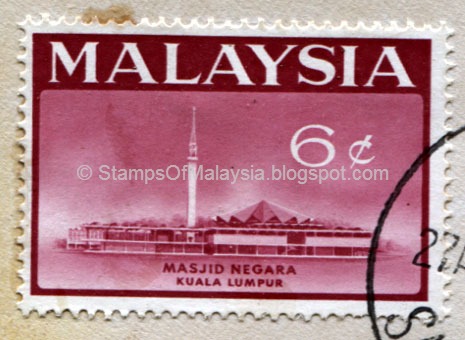
The Opening of the National Mosque

At its meeting on the 30th July, 1957, the then Executive Council agreed in principle that the Federation Government should make a substantial contribution towards the construction of a National Mosque in Kuala Lumpur as a gift form the people of the Federation to the Yang Teramat Mulia Tunku Abdul Rahman Putra, then Chief Minister, in appreciation of his services in leading the country to independence.

At a meeting on the 5th March, 1958 of the Menteris Besar and Chief Ministers of the eleven states comprising the Federation of Malaya, it was agreed in principle to construct a National Mosque in Kuala Lumpur to be named "Masjid Tunku Abdul Rahman Putra". A Central Committee headed by the Deputy Prime Minister was formed to be responsible for the administration of the funds, acquiring the site, construction of the Mosque and determining the policy for the collection of funds, etc. throughout the country. The name has been changed at the request of the Prime Minister, Tunku Abdul Rahman Putra to Masjid Negara (National Mosque).

The National Mosque was designed and supervised by the Architects and Design Research Branches, Federal Public Works Department and has taken just over 3 years to complete at a cost of $10,000,000.

Public donations have been received from people of all races and religions in the country. The mosque in fact symbolizes the goodwill and brotherhood of the people.

It stands diagonally opposite the Central Railway Station of Kuala Lumpur, the capital of Malaysia in a laid out garden of approximately 13.5 acres. It forms an impressive termination point to a long view from one end of the multi-level fly-over which spans the Klang River.

The building itself occupies an area of almost 5 acres and consists of the Grand Prayer Hall providing a floor area of 22,500 sq. ft., the Dewan, the Mausoleum, the Library, Offices, the open courtyard and the Minaret.

The Grand Hall is surrounded by deep verandahs which are screened off by gleaming white terrazzo grille work of traditional Islamic designs similar to those in the mosques at Agra and Patephur Sikri in India. It is covered by a high pleated shell concrete dome taking the shape and form of an open umbrella and is supported by 16 columns each of 3'0" diameter. The span of the dome is approximately 145'0" from centre to centre of columns, its apex rising 84'0" above the floor level.

The Grand Hall and the verandas provide a praying space of 80,000 sq. ft. which can accommodate 8,000 people. The floor of the Grand Hall will be covered with fixed carpet whereas the rest will be finished in precast terrazzo slabs.

The Dewan is located on the south side of the Mosque and is an all purpose hall which can seat 500 persons. It has an interesting shell concrete roof in the form of pleated and connoid vaults and is connected to the Main building by a short but wide covered way which during Ramadzan and other religious occasions will serve as a feasting area and also a dias for the annual Quran Reading Competition.

The Mausoleum, situated at the rear of the Mosque, stands in a circular reflecting pool and is connected to the main building by a covered footbridge. It is circular in design and is also covered by a pleated shell concrete dome similar in shape to that of the Grand Hall but having only seven folds one of which covers a reserved area for a National hero's tomb.

The air-conditioned Library and offices are situated to the rear of the main building.

The open courtyard is an important element in the tradition of mosque planning and is placed in front of the Grand Hall. Courtyards in mosques in the Middle East are open to the sky and are invariably furnished with a cluster of fountains in a pavilion or an open pool where ablutions can be performed. The courtyard in the National Mosque is partly covered by 48 independent concrete parasols to provide shade and architectural contrast, the fountains for ablution being located at the floor beneath.

The Minaret is square on plan 12'6" & 12'6" rising from the centre of the long and narrow reflecting pool by the side of the Grand Hall. It has one viewing balcony 138' above the main floor which is accessible by a lift and a spiral staircase. The top of the minaret is decorated with a concrete spire which takes the form of a closed umbrella and soars 90' above the balcony. This completes the theme of the design of the National Mosque, Masjid Negara in Malay, which is based on an open umbrella for the dome over the Grand Hall and a closed umbrella for the spire.

The main floor level of the building is 32' above the Road and is accessible on three sides by wide staircases. The main entrance is on the east side and will primarily be used by those who come on foot whereas those who visit by cars will enter by the south entrances adjacent to which car parks are provided, the north entrance being used by those visiting the Mosque via Young Road.

Ladies have a separate entrance directly connected to the Ladies Ablution Hall and they will offer their prayers in the Gallery at the north end of the building. This Gallery also provides booths for Television and Radio services and sitting accommodation for visitors wishing to witness proceedings held in the National Mosque.

Technical details
Special postage stamps of the 6 cents denominations will be issued on the 10th April 1965 to commemorate the opening of the National in Kuala Lumpur.

Size: Rectangular in horizontal format with the following dimensions perforation to perforation in sheets of 100 stamps :-
(a) Horizontal 36 mm
(b) Vertical 25 mm

Printing Process: Photogravure
Design: A drawing of the National Mosque
Colour: 6 cents - Carmine
15 cents - Chocolate
20 cents - Deep Bluish Green
Paper: PTM Watermarked white paper
Printed by: Harrison & Sons, London

The stamps will be placed on sale in all territories of Malaysia for a period of three months from the date of issue or until stocks are exhausted whichever in earlier.

Stamps in the series


First day cover

Sunday, June 8, 2008

The official opening of the Sultan Salahuddin Abdul Aziz Shah Mosque State Mosque of Selangor Darulehsan

Commemorative issue of postage stamps to mark the official opening of the Sultan Salahuddin Abdul Aziz Shah Mosque State Mosque of Selangor Darulehsan

Date of Issue: 1988-03-11
Denominations: 15 cents, 20 cents and $1.00
Stamp Size: 29.85 mm x 40 - 64 mm
Paper: SPM watermarked phosphor coated
Printing Process: Lithography
Printer: Security Printers (M) Sdn. Bhd. Petaling Jaya, Selangor, Malaysia
Sheet Composition: 50 stamps
Designer: Raja Zahabuddin Raja Yaacob

Stamps in the Series:

First Day Cover:


The Sultan Salahuddin Abdul Aziz Shah Mosque is the largest in Malaysia and one of the most beautiful in South East Asia. The mosque costing over $160 million is built on a site of approximately 36 acres of land situated to the north of Shah Alam town Darul Ehsan. The design of the mosque reflects a blend of traditional Islamic Mosque architecture and local Malay architecture. The ground floor of the mosque consists of an office, meeting and conference rooms, the library, the reception, the classrooms and the storeroom.

The main prayer hall covers an area of 73,000 square feet and is surrounded by verandahs on its three sides except for the mihrab side. The total prayer area is about 162,000 square feet and can accomodate up to 16,000 people in one season. The prayer hall is structured so as to provide constant air movement. With a fair number of extract fans and fresh air piped in through the pole ducts, the main prayer hall provides an atmosphere for carrying out prayers in comfort.

The carpet on the floor of the main prayer hall is made of fine worsted wool bearing geometric patterns on a blue background. The pilasters and walls are lined with Mahsuri White Langkawi Marble while the mihrab wall is lined with imported marble. The center of the mihrab wall framed within two pilasters is finished with antique Turkish tiles whereas the mihrab design itself consists of white marblework, decorated with traditional Quranic verses. The main prayer hall has four large chandeliers.

Ablution facilities are located in a separate building with access to the main prayer hall. Another special feature of the Mosque is the special prayer hall for ladies. The ladies prayer hall can be reached directly by a small staircase from the ladies ablution area on the ground floor. Below the main prayer hall is a Hall which can be converted into an additional prayer hall when necessary.

The courtyard floor has patterns in green slate and white tiles. The floor has a hidden fountain system which springs into display when activated. The water disappears and the floor dries up when switched off, ready for use as extra space for prayer. The center of the courtyard which is raised to the same level as the main floor could be transformed into a dais for Quran Reading Competitions.

The two side walls of the gallery are constructed entirely with aluminium grills covered with coloured glass. This is the largest stained glass wall ever built in the country.

The dome of the State Mosque, 180 feet high and 170 feet in diameter designed by computer is believed to be the largest of its kind in the world. The structure of the dome was designed with the tubular triodectic system using aluminium. The dome soaring up to 300 feet above the ground carries decorative steel panels, each triangular in shape, finished in vitreous enamel of blue and light grey. It is free from rust and long lasting. Besides this a 35 feet high aluminium finial finished in gold crowns the dome.

Using a similar technique, an inner dome was built where the lower profile formed by the tubular triodectic system are filled with timber lattice work which provides ample Islamic design. The result is a traditional design capped with a special rossette of Quranic Verses at the apex which is written in blue script on a golden yellow background.

The ring beam on which the domes are built is finished in vittreous enamel panels carrying blue Quranic Khat on light grey background. For the inner dome, the ring beam carries Al-Yassin Quranic Verses in golden yellow on blue background. This decorative khat is the work of a famous Egyptian 'Khatar' Sheikh Abdel Moneim Mohammed Ali El Sharkawi. Pinball lights are fixed on the timber ceiling of the dome for 'starry night in the desert' effect.

Four identical minarets are situated at the main corners guarding the dome of the Mosque. The 28 feet wide and 460 high Minarets which are tallest in the world have three tiered crownests each accessible by spiral staircases. One of the minarets near to the lake is serviced by a lift to the highest landing at 358 feet level. The minarets also carry aircraft warning lights at the top which are terminated with star and crescent shapes. All the crownests carry horn speakers and floor lights which provide illumination for the dome.

Monday, May 26, 2008

Musical Instuments of Malaysia

Musical Instruments of Malaysia

Date of Issue: 1987-03-07
Denominations: 15 cents, 20 cents, 50 cents, 80 cents
Stamp Size: 27.94 mm x 44.45 mm
Paper: SPM watermarked, phosphor coated
Printing Process: Lithography
Printer: Security Printers (M) Sdn. Bhd. Petaling Jaya, Malaysia
Sheet Composition: 50 stamps
Designer: Ms. Kathy Wong

Stamps in the Series:


First Day Cover:


Musical instruments in Malaysia comprise of various types of traditional instruments and may be divided into various groups such as the wind and the stringed instruments. Some of these instruments form an integral part of a Malay ensemble. Some of the musical instruments in use today are derived from those of old and have been re-designed by adding modern decorative elements to consonise their contemporary needs. Some of the more common musical instruments are the rebab, serunai, sapih, sompotan, kompang, and the gendang. These instruments are played in many different styles according to their particular genre and performance practices.

Sapih

The sapih is classified as a chordophonic instrument and is popular among the indigineous people of Sarawak mainly the Kayan, Kenyah and Kelabit. The four wire strings on the sapih are stretched horizontally across its body on top of the many low fret-like movable bridges which are placed on top of its neck or fingering board. The first of the four strings creates the melody while the remaining three strings produce the drone sounds. Earlier models of the Sapih used only two strings made out of finely split rotan. The Sapih can be played as a solo instrument or in a duet to accompany a warrior like dance called Ngaja, and the Datun Julud which is performed by ladies.

Sompotan
The sompotan is an aerophonic traditional musical instrument popular among the Dusun people of Sabah. This instrument consists of bamboo pipes with single reed tongues fitted vertically into the empty shell of a small dried gourd which functions as a wind bellow. The pitch on the sompotan is controlled by the ability of the player in the usage of his fingers on the finger holes and the pipe ends. The sompotan produces a sweet tone and is capable of producing drone bass sounds together with harmony. The sompotan can provide entertainment as a solo instrument as well as in an ensemble.

Serunai

Serunai is the only aerophonic Malay traditional musical instrument present in the Wayang Kulit Kelantan, Menora and Silat ensemble. The serunai is used as accompaniment in the court dances known as Tari Asyik and Inai. The serunai has quadruple reeds made from the palmyra palm and is the principal melodic instrument in an ensemble. This instrument is made of a conical tube of hardwood which has seven finger holes in the front and one at the back. The instrument is usually ornamented with carvings at the upper and lower ends of its body. Melody is produced by means of a circular breathing technique in which the flow of air through the reeds is never stopped.

Rebab

The rebab is a three-stringed chordophonic Malay traditional musical instrument. The instrument has an elongated triangular-shaped body carved from hardwood, usually the wood of the jack-fruit tree. The front face of the body is covered with a layer of the cow’s inner stomach, and a small lump of bee’s wax is attached to the upper left side of the stretched skin. The rebab commonly referred to as the spiked fiddle is played with an intricately carved bow. The rebab is the melodic instrument in the Mak Yong and the Main Petri ensemble. In the Tarik Selampit tradition the rebab appears as a solo instrument played by Tok Selampit himself.

Sunday, May 25, 2008

Historical Building

Historical Building

Date of Issue: 1986-12-20
Denominations: 15 cents, 20 cents, 40 cents, and $1.00
Stamp Size: 28mm x 38mm
Paper: SPM Watermarked, phosphor coated
Printing Process: Lithography
Printer: Security Printers (M) Sdn. Bhd. Petaling Jaya, Malaysia
Sheet Composition: 100 stamps
Designer: Peter Khang Howe Ket

Stamps in the Series:

First Day Cover:


Malaysia is a sovereign state with a colorful history. Its periods of historical turbulence have left behind legacies, which are manifestations of the country’s development in the various social and economic fields. One such legacy is its historic buildings, which are beautiful and possessing unique architecture. The Antiquities Act of 1976 governs historic buildings in Malaysia, the aim of which is research, protection and the preservation of such buildings.

Istana Lama Seri Menanti, Negeri Sembilan (15c)
The Istana Lama Seri Menanti situated at Seri Menanti in the district of Kuala Pilah was built in 1902 to replace the old palace which was burnt down by British soldiers while pursuing Yam Tuan Antah in December 1875. This Istana was occupied by His Royal Highness The Yang di-Pertuan Besar Tuanku Muhammad until 1931. Built of wood, the Istana consists of four storeys and is based on the Minangkabau architecture. This unique building has a three-tier minaret in the center. Wood for the four columns of the Istana was acquired by the local inhabitants from the jungles of Bukit Perigi, Jelebu and Bukit Tinggi Kuala Pilah. The summit in the center is known as ‘Tingkat Gunjung’. Unique and extraordinary carvings and motifs can be seen on the outside walls and along the columns of the balcony.

Istana Kenangan, Perak (20c)
Istana Kenangan which is situated at Bukit Chandan, Kuala Kangsar, Perak was planned after a disastrous flood struck Perak in 1928. The construction of the building was completed in 1931. His Royal Highness Sultan Iskandar Shah, the 30th Sultan of Perak (1918 – 1938) moved into Istana Kenangan so that the Istana Negara could be demolished for the construction of a new Istana (the present Istana Iskandariah). His Royal Highness moved into the new Istana Iskandariah upon its completion in 1933. Members of the Perak royal family however, occupied Istana Iskandariah. Istana Kenangan also known as Istana Lembah and sometimes as Istana Tepus has specially designed walls and roof and almost the whole building is constructed of wood.

Stadthuys, Melaka (40c)
The Dutch built a residence for their Governor between 1641 and 1656 at the site of the Portuguese Governor’s residence, which was destroyed during the war between the Portuguese and the Dutch. The Governor’s residence was also known as Stadthuys in Dutch. This building is the original and the oldest amongst the Dutch building in the Far East. The oblong shaped Stadthuys building consists of three storeys out of which one was used as a storeroom. On the right were the slaves’ rooms as well as the warehouse.

Istana Kuching, Sarawak ($1.00)
Istana Kuching situated across the Sarawak River and Kuching town was built in 1870 as the residence for the Head of State. Istana Kuching was an official and prominent building in the history of Sarawak. The building is divided into three separate bungalows supported by concrete columns measuring 20 feet in height. The large intermediate building was used to entertain state guests. The other two portions were used as bedrooms.

Tuesday, April 29, 2008

Traditional Malay Weapons

Traditional Malay Weapons

Date of Issue: 1984-05-30
Denominations: 40 cents
Stamp Size: 39.19 mm x 24.13 mm
Paper: Unwatermarked
Printing Process: Lithography
Printer: Harrisons & Sons (High Wycombe) Ltd., England
Sheet Composition: 100 stamps
Designer: Peter Khang Howe Ket

Stamps in the Series:

First Day Cover:

Traditional Malay weapons can be classified into swords, daggers, spears and also the cannon. The most well-known of these weapons is the dagger, that is the keris, badik, tumbuk lada, pedang, golok, beladau, lawi ayam, tombak, meriam and the ekor lutong. The keris has been the national weapon of the Malay people for over five hundred years. However, today the keris and other traditional weapons are being made more for decorative and ceremonial purposes.

Keris
A keris is primarily a weapon for thrusting. Basically there are five types of keris namely the keris from the Northern States of Peninsular Malaysia and Patani, from Rembau, the Javanese Keris, the Bugis Keris and the Sumatran Keris. The keris can be further classified according to the parnor, the iron used, the shape of its blade and the hilt. A keris must be made of at least two kinds of metal. Some keris have been known to contain even up to seven or more kinds of metal.

The blade of a keris is double-edged and it tapers to a point. It can be between twenty and forty cm in length and is either straight or sinuous, depending on the type of keris. Normally, there are three, five or seven waves but some keris even have nineteen waves. The sheath of a keris is normally made of ornamental wood and can be plain or intricately carved.

The most beautiful part of a keris is the hilt which is carved from hard wood, horn, bone or ivory depicting a variety of decorations such as the hulu pekakak (Kingfisher's Head) and the hulu burung (Bird's Head). A keris with hulu pekakak is part of the regalia of His Majesty the King.

Tumbuk Lada

The tumbuk lada has a straight blade and usually does not exceed twenty cm in length with only one cutting edge. Its hilt is normally tubular and is carved so that the top resembles a pepper crusher hence its name, tumbuk lada. The sheath of the tumbuk lada is normally carved.

Wednesday, April 16, 2008

Traditional Handicrafts of Malaysia

Special Issue of Postage Stamps on Traditional Handicrafts of Malaysia

Date of Issue: 1982-11-26
Denomination: 10c, 15c, and 75c
Stamp Size: 31.93mm x 48.26mm
Paper: White unwatermarked security postage stamp paper
Printing Process: Offset lithography
Printer: Messrs. Harrison & Sons Ltd., High Wycombe, England
Sheet Composition: 100 stamps
Designer: Ajib N.S. Kuala Lumpur

Stamps in the Series:

First Day Cover:


Special Issue of Stamps
The theme for the second special issue of postage stamps for 1982 is ‘Traditional Handicrafts of Malaysia.’
Traditional Handicrafts of Malaysia
Traditional handicrafts of Malaysia form an invaluable part of the nation’s cultural heritage. Equally certain is their endangered position, their need to be nurtured and kept alive. The handicrafts portray a historical and socio-economic background which provides perspective and a deeper understanding of their place in Malaysian society.
The days of aristocratic patronage are over and changing times bring changing tastes.
There is a need for a new strategy to make these crafts economically visible without destroying their aesthetic value through commercialization and standardization.
Conscious of these changing circumstances, the Postal Services Department has decided to include 3 handicrafts in its special issue of postage stamps viz. Sabah Hat, Gold Threaded Cloth and Pottery.
The special issue of postage stamps consists of 3 denominations as follows:
10c – the design depicts Sabah Hats in full color. The wordings are in white and black.
15c – the design depicts Gold Threaded Cloth in full color. The wordings are in white and black.
75c – the design depicts Pottery in full color. The wordings are in black.
10c denomination

Local Name: TERENDAK SABAH
English Translation: SABAH HAT
Seraung or ‘Sabah’s Traditional Hat’ is widely used by the people in the state of Sabah particularly the indigenous communities such as the Kadazan or Dusun from the districts of Penampang, Tambunan, Papar and Keningau.
It is the product of skilled handicraft work using raw materials found in the state of Sabah. Seraung is conical in shape and bamboo embroidered and is weaved together with rotan at the cylindrical base. With the use of local dye, Seraung is colored with a background of light yellow and wavy stripes in black and red running from top to bottom the pattern and shape of a pyramid.
Seraung is traditionally used on various occasions such as padi harvesting times in several districts and also during Kadazan Celebrations popularly known in Kadazan as ‘Tadau Kaanamatan’. Tadau Kaanamatan is celebrated annually around the 13th of May by Kadazans in the state of Sabah.
15c denomination

Local Name: KAIN SONGKET
English Translation: GOLD THREADED CLOTH
Songket is a traditional Malaysian hand woven fabric. It is woven on the traditional two-paddle floor looms by Malays women in the North Eastern Coast of the Peninsular. Chemically dyed yarns of silk or cotton, and sometimes, a combination of both is used as wefts and warps of the fabric. Gold or metallic thread is inlaid as tapestry to form the intricate designs.
If one studies the woven pieces of Songket and other woven fabrics one can see that Songket has its own special technique of waving and is different from other woven pieces. Songket, like in brocade, has no floating over shots of the waft, to emphasize the design. In Songket, all warp threads are carefully counted and arranged in such a way that no over shots will appear on the right side of the fabric. Usually, the traditional songket designs are very intricate, metallic or gold threaded, covering the whole fabric, with paneling (Kepala) decoratively adorned with bamboo shoot motifs. Each songket has either one or two paneling followed by a smaller border running horizontally on each side of the panel. Most of the time they have only one long elaborate panel. In traditional songket, they even have songket in ‘ikat’ called ‘kain cindai’.
Patterns used are usually local flowers scattered or done all over, and which appear geometrical. Since songket is used for special occasions and at ceremonies the colors selected here are rich, primary and bright to emphasize the richness of the gold thread. Maroon, yellow, green, brown, blue are the colors mostly used in the warp and weft threads of songket.
75c denomination

Local Name: TEMBIKAR
English Translation: POTTERY
Pottery is a handicraft popularly produced by the people of Sabah, Sarawak, Sayong in the state of Perak and Mambong in Kelantan. Sarawak pottery is intricately decorated with unique ethnic motifs. Glazed and unglazed, shapes follow the lines of Chinese porcelain originally traded in the riverside jungle areas of North Borneo many centuries ago.

The ceramic pottery of Sayong, Perak is normally blackish in color, and mostly used as water coolers because of its porosity, while Mambong pottery consists of brownish red earthen pots, mainly for cooking.